Not a washer
It removes dry dust, not oil
It handles dust loading — silica, road grit, harvest chaff. It does not remove oil mist, soot or water contamination. Those elements still need replacement.
One machine, one job: put a cylindrical element back into service without tearing the media. Everything on this page is factory specification — there are no optional extras to price separately.
A bench-mounted cleaner for cylindrical air filter elements. Compressed air enters through a regulator, spins a cleaning head at up to 6,600 RPM, and drives a vortex through the element from the inside out. Dust leaves the pleats; the media stays intact.
The element sits on a Ø305 mm base plate and is held by a positioning plate that adjusts across a 100–300 mm bore range, so the same unit covers the standard filters on trucks, plant and farm machinery.
| Product name | Pneumatic rotary air filter cleaner |
|---|---|
| Power source | Workshop compressed air |
| Rotational speed | Up to 6,600 RPM |
| Base positioning plate | Ø305 mm · 50 mm thick |
| Positioning range | 100 mm – 300 mm |
| Main operating rod | Stainless steel Ø20 × 600 mm |
| Top protective plate | Ø100 mm disc |
| Hose clamping diameter | 80 mm – 180 mm |
| Pressure control | Integrated regulator + analogue gauge |
| Safety protection | Automatic overpressure relief valve |
| Construction | Aluminium head, stainless operating rod |
| Electrical requirement | None |
The manifold sets the pressure, the plate centres the element, the head does the work.
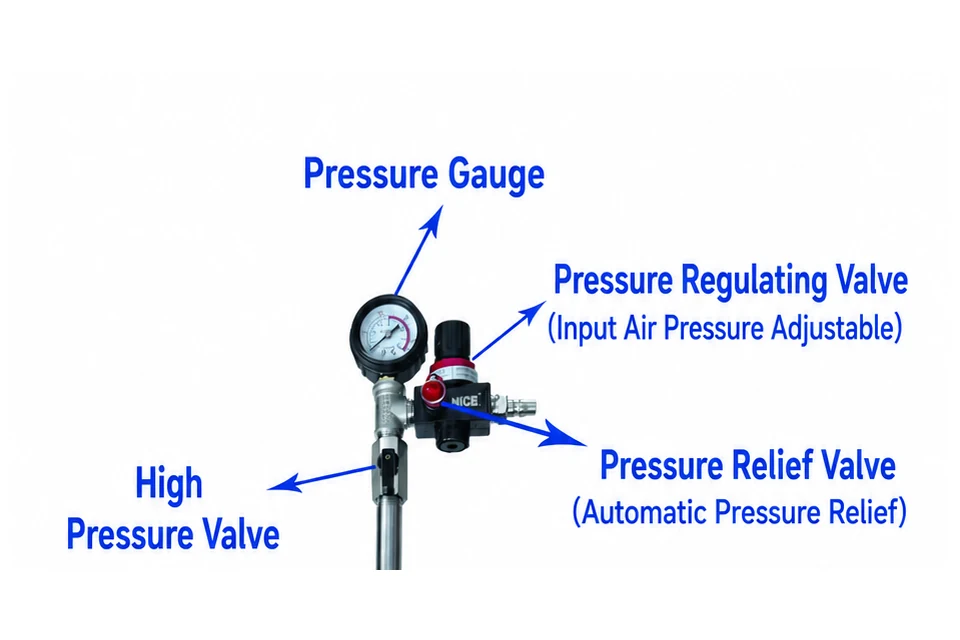
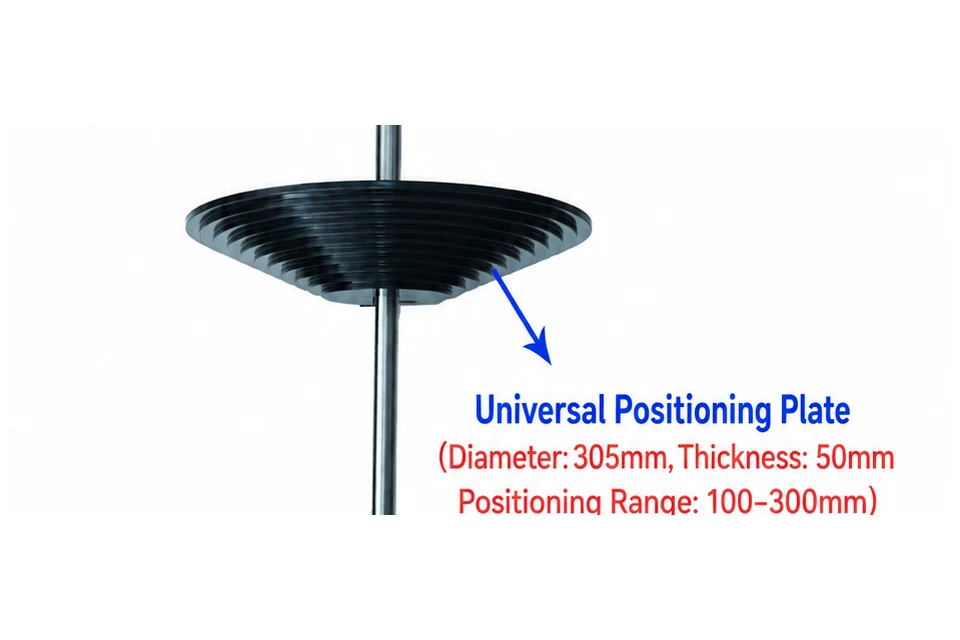
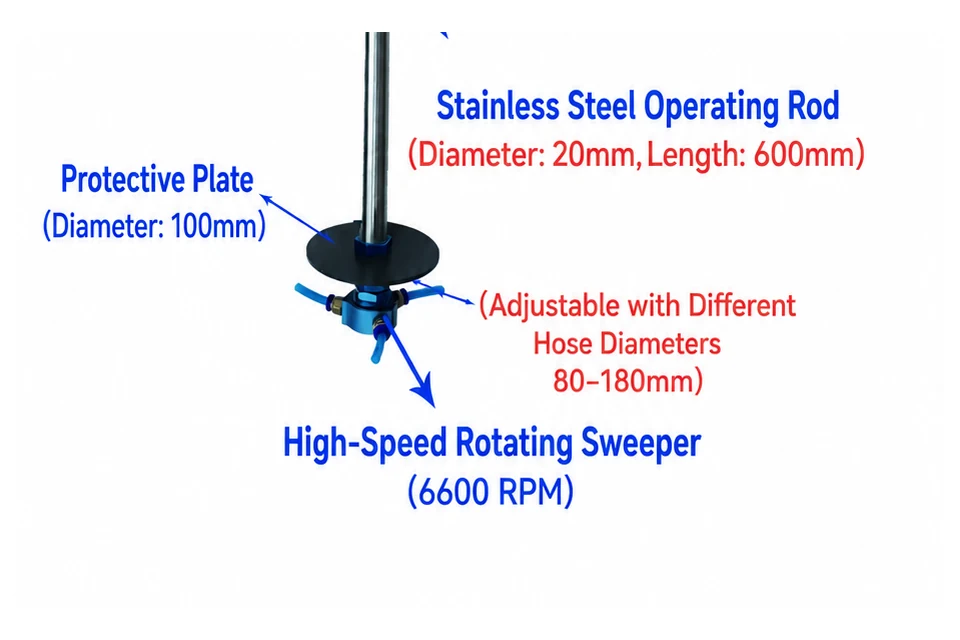
Two measurements decide it: the bore of the open end, and whether the element is cylindrical. A tape measure and ten seconds.
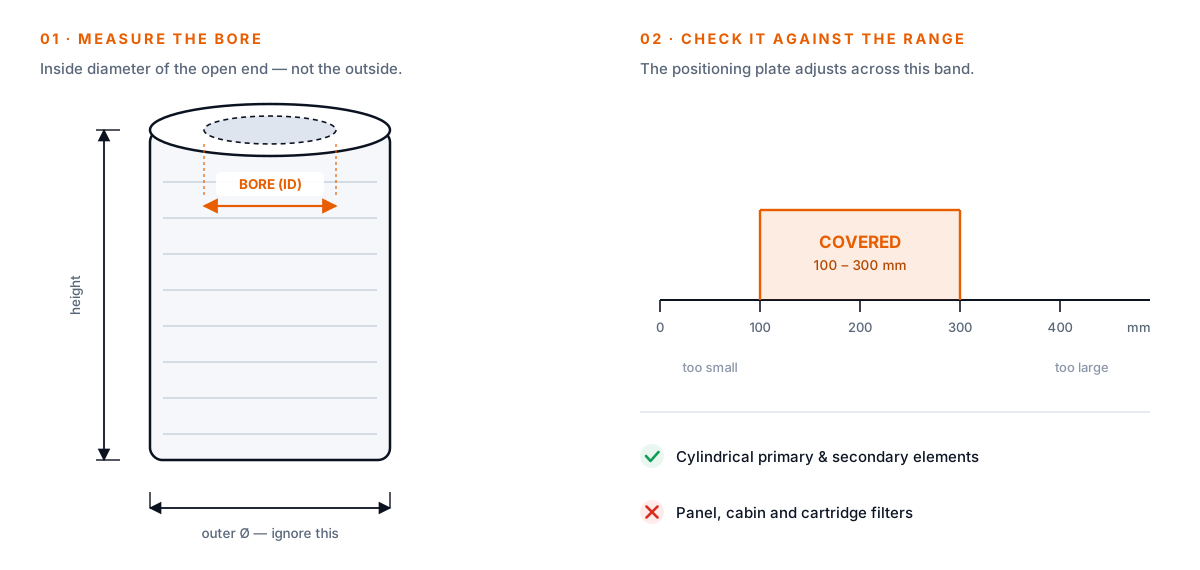
Send the bore, the height and a photo with a ruler in frame if you are unsure. We would rather confirm the fit than sell you a machine that sits in the corner.
Two files, no form to fill in. Send them to a colleague or keep them in the maintenance folder.
Two pages: full technical data, the bore measurement diagram and the ordering terms. A4, print-ready.
PDF · 229 KB · Download →Safety notes, the four-step procedure, how to set pressure for the media in front of you, and a fault table.
PDF · 163 KB · Download →No training program and no electrical connection. If the bay has an air line, it has everything the cleaner needs.
Centre the cylindrical filter on the Ø305 mm base plate.
Set the positioning plate to the filter bore, anywhere from 100 to 300 mm.
Connect workshop air and dial in pressure on the regulator — read it off the gauge.
The head rotates and the element is evacuated from the inside out. Hands free.
A cleaner is only useful if it is bought for the right job. These are the jobs it is not for.
It handles dust loading — silica, road grit, harvest chaff. It does not remove oil mist, soot or water contamination. Those elements still need replacement.
Flat panel filters and cartridge-style cabin filters are outside the 100–300 mm bore range this machine is built around.
If the pleats are torn, collapsed or soaked, cleaning will not bring the element back. The cleaner protects good media — it does not restore failed media.
A blowgun, a handheld rotary lance, or a bench unit. They are not the same job — here is where each one actually wins.
| Criterion | Manual blowgun | Handheld rotary lance | Bench unit — this machine |
|---|---|---|---|
| How it works | One nozzle on a trigger | Rotary nozzle on a flexible lance, pushed into the element | Element sits on a Ø305 mm plate, head rotates on a fixed rod |
| Pressure control | Whatever the compressor is set to | Whatever the compressor is set to | Regulator and gauge on the unit, set per element |
| Operator time | Hands on for the whole job | Hands on for the whole job | Hands free once the valve is open |
| Repeatability | Depends who is holding it | Depends who is holding it | Same procedure, same pressure, every shift |
| Media protection | Tears if you linger in one spot | Better — but still operator-dependent | Relief valve plus a visible pressure reading |
| Filter range | Anything | Varies by kit and nozzle set | 100–300 mm bore, cylindrical elements |
| Where it wins | Cheapest tool, tight spaces, one-off touch-ups | Works anywhere — no bench, no mains air, goes to the machine | A workshop where the element comes to the bay |
Send the filter types you service, the quantity you have in mind and the destination country. You get technical confirmation plus an FOB or CIF price within 12 hours.
Fields marked * are required.